strategies for waking up well
Waking Up From Freeze or Collapse
For many folks waking up in the morning can feel impossible. This first moment of consciousness for the day can set our nervous system up for how we treat the rest of our day. And for folks recovering from trauma or with a sensitized nervous system it can be quite the task to get out of bed in the morning.
Waking up is a transition towards physiological activation in our nervous system: cortisol, norepinephrine, histamine, acetylcholine, and dopamine increase, heart rate elevates, melatonin falls, body temperature begins to rise, breathing rate becomes slightly faster, causing the body to transition. This physiological activation in itself is not inherently distressing, the body isn't doing anything wrong here. And the state we are in can influence how we interpret this massive shift in consciousness.
When someone has experienced trauma or for other reasons are sensitized their nervous system may be biased towards vigilance and interpret this massive transition through those lenses. The activation gets associated with threat and the nervous system responds accordingly, with a stress response (many times collapse of freeze). It is important to note, the physiological activation is not something we need to change or shift, rather when tending to ourselves in waking we want to re-associate with enough safety, connection and choice over time and with repetition our nervous system can update those sensitized predictions to ones of safety. This then sets the foundation for predictive processing for the rest of our day.
So, how do we build scaffolding and practices to support? The good news is we have so many options!
Gentle Movement
Wiggle your toes
Invite in small movements into your furthest extremities. When it is challenging to make the big movements to get out of bed, set the bar somewhere you can be successful, take a deeper breath, wiggle your toes, make the smallest, slowest movements you can make. The less pressure the better. Forcing yourself will only send signals of distress to your nervous system. thing “I can…” and take that small action.
Supine Twist
Start to bring that movement into the spine and twist it out. Move as slow as your nervous system needs. Staying on each side for as long as you would like. Keep a hold of the pillow if you’d like. Really listen to the pacing of your body here.
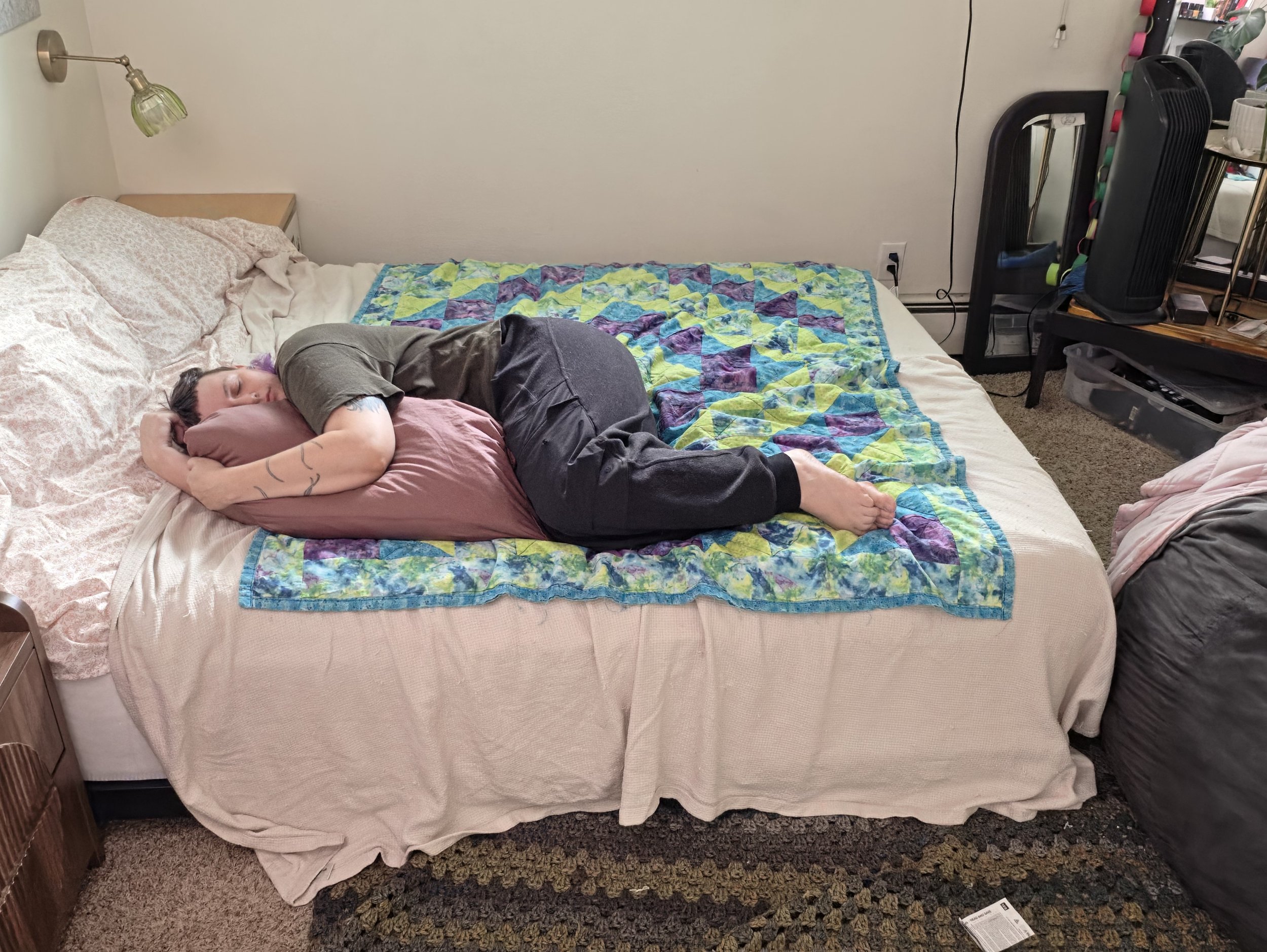
Side Laying Rest
While still in bed, give yourself permission to keep your eyes closed. Stay under the covers and move as slowly and gently as you need.
Invitation to reach for a pillow and pull it in towards yourself. Wrap you arms and legs around the pillow giving it a big cuddle. A first signal of safe connection. If you have a partner or pet that is amenable you may even reach for a snuggle with them in this Side Laying Rest.
Supine Figure 4 Twist
Add in some expansion into the hips and then into the side body. Finding a little more expansion in these next shapes. Cross one leg over the other in a figure four and shift the hips from side to side. Breath into the hips. Add in the arms over head our out to the side. Get a little side stretch in with this twist, breath into the side body, hips to ribs. Make sure to swap out the legs and do both sides.
Full Body Stretch XO
Getting into some bigger movements here. As you inhale reach your arms and legs trying to reach the corners of your sleeping space. Exhale, and curl up into a ball. Stay in each shape as long as you would like.
All together
Side Laying pose
Wiggle your toes
Supine Twists
Supine Figure 4 twists
Add arms over head
XO Full Body Stretch
Supported Bridge
Successfully out of bed
Back Bend Out
Roll onto your back and start to scooch your way to an edge. Get your feet to touch the ground. Feel the ground under your feet and a gentle opening across the front of your body. You might even press the feet into the ground and lift your hips to bring some more energy in the shape. Then slide forward to open from the upper back. then curl forward. Give yourself a hug. You did it you are out of bed.
Guided Orienting
Orienting is a foundational somatic tool to support grounding and presence. It gives our body the answer to the questions “Where am I?” and “Is this place safe enough?” It isn’t about gaslighting our brain into seeing safety where it isn’t but about opening up the door for us to see cues of safety that might be there.
Orienting is the intentional activation of an inherent reflex to scan our environment for cues that let our nervous system know if it is safe. If we are predisposed to scan for threat, due to trauma or sensitization, intentional practices of orienting can support resetting the nervous system over time to the reality of the variety of what our environment is offering.
This particular orienting practice is intended to be used in the morning while waking up to support a state shift for folks predisposed to waking up in a stress, specifically freeze and collapse. The goal is awareness, becoming more connected to what is happening here and now. We are not forcing ourselves to feel any particular way as this sets up more pressure on our nervous system in a state where it is already primed to see threat. What we are signaling to our nervous system is “I am here and now and this is what is observationally real.”
If you notice that orienting to your space continues to cue stress, it may be be helpful to establish sensory anchors that cue “safe enough” where you sleep (see below for more guidance). This is a practice and will take time to feel the long term effects.
In the short term you may notice feeling a sense of calm, emotions bubbling up to the surface (because I have history of sleep trauma, I often end up crying when practicing orienting), feeling nothing, feeling a mix of relief and mobilization/stress. Whatever you experience, it is the “right” experience. Simply continue to anchor into the present.

Sensory Anchors
Sensory/Somatic Anchors are simply anything you can feel sense with our body that helps you stay connected to something. Much of the time they are used to anchor us to the present moment. These anchors can develop unconsciously AND we can cultivate them.
Here we will talk about how to cultivate them intentionally to support orienting in the morning and signaling safety to your nervous system in the morning. Everyone’s sensory profile is different and can change over time so there is no one size fits all. This requires you to get curious and experiment with what your body needs.
Environment Shapes Experience
Behavior and experiences don’t happen in a vacuum. It is an interaction between you and your environment. When we can shape our environment we can support feeling, being and doing differently. Environmental factors don’t determine your experience on their own, but they can prime you and give you buoy to anchor onto when you wake up in freeze or collapse. So let’s shape the environment you wake up in.
-
![]()
Sight
Although sight is one sense, there are many factors that we can alter when with think about sight based anchors.
Start with what it
Take a look around the space that you sleep in. What are your eyes drawn too? These things do not need be be physical things, but may be qualities or aspects of the space (wall color, light quality, openness. coziness). Notice what you feel in you body when you look at those things? (You might even do this while in the physical spot you sleep)
Modifications
If there are things that bring you joy, make you feel at ease, bring a smile to your face, start there. Can you make those easily visible?
If there are things that bring in feelings of overwhelm, distress or anxiety, can you remove them from the space or make them less visible? Can they go in a drawer, in a closet, in another space, or even, just out of your sight line when waking.
Once you have done these things here are some additional things to consider.
Visual Business
Visual clutter, business and complexity can increase cognitive load and attentional demand which may be contributing to how you feel when you wake up. The brain is always processing its surroundings, even when your consciously doing so. A visually busy environment may be asking you to filter and make sense of a lot of information when you first wake up. One element to play around with is the visual business of your space and prioritizing things that bring you calm or joy.
Plants
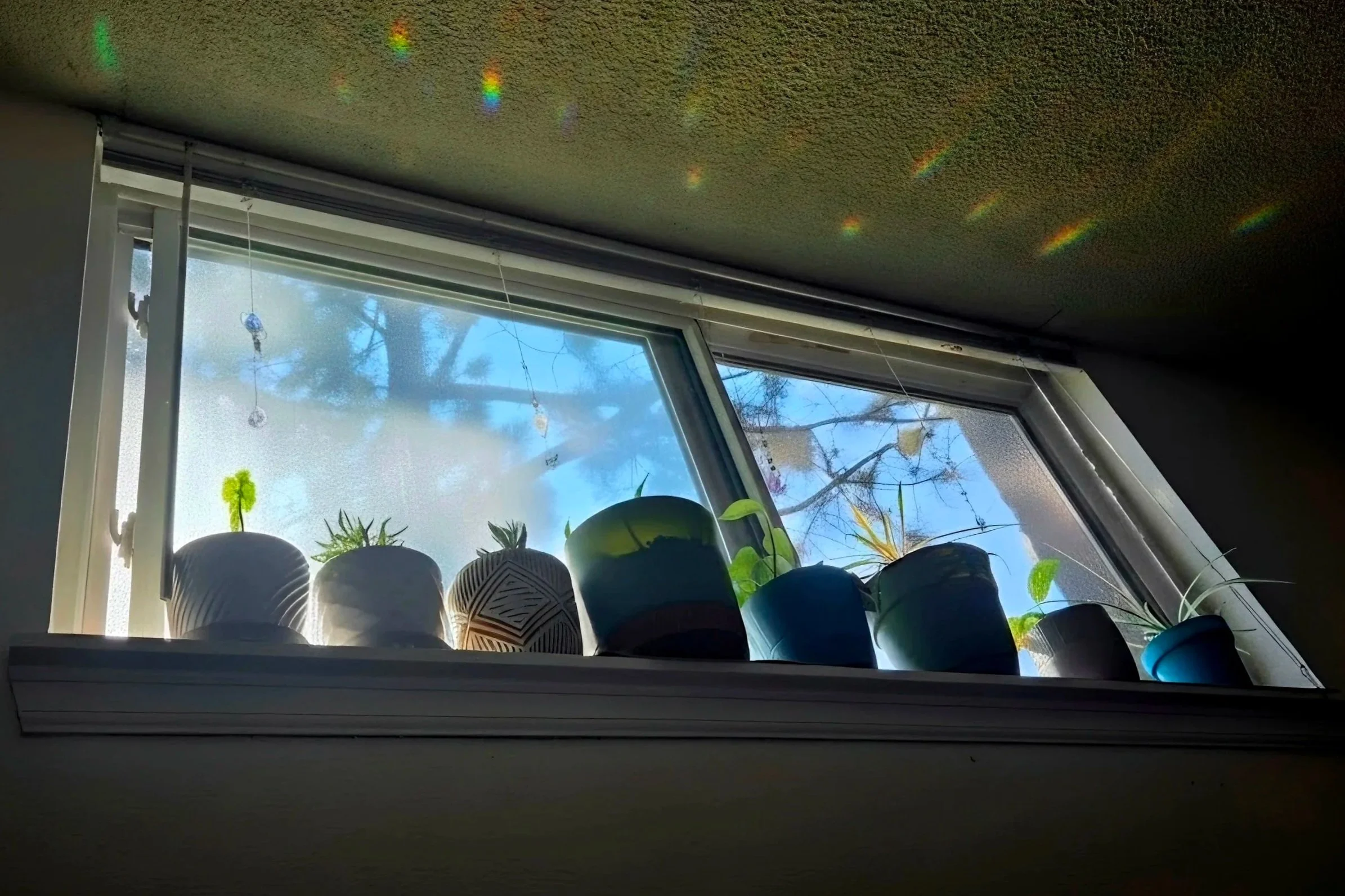
Indoor plants have been shown to have positive effects on bodily arousal showing correlation between houseplants and lower blood pressure, lower heart rate, reducing self reported anxiety and feeling more calm and relaxed. Consider a house plant (alive or plastic) as a visual anchor to wake up to. Experiment and notice how it feels for you?
Quality of Gaze
The quality of your use of sight may be an important factor to consider. When teaching yoga I give the cue to “soften around the eyes and slowly blink them open.” This is intended to communicate calm to the nervous system. What works for you may be different. I encourage you to play around with differnet qualities of your gaze:
the softness-intensity of your gaze
the distance (close-far) at which you gaze (my preference for my nervous system is far away)
the pace (fast-slow) at which you move your eyes
whether it is with the head or apart from it
the level of focus (narrow-wide) you use.
See what qualities of gaze feel like in your nervous system.
Doors and Window
Doors and windows create the permeability of our space. Depending on your needs, consider using doors and windows as anchors when waking up. In the case of containment, they may help you zoom in and feel held as you transition into wakefulness, maybe they create a sense of safety because you can see that they are closed and locked, or maybe you have them open, to cue your system there is a way out or to provide the ability to gaze softly at a at a distances and access the outside world.
Art
Art can be a powerful emotional stimulator. It can be evocative and bring elements into our space that we may not otherwise have access too in our wakeful moments. Consider using a piece of art as your visual anchor for waking up.
-
![]()
Sound
-
![]()
Smell
-
![]()
Taste
-
![]()
Pressure/Support
Description goes here -
![]()
Light
Light, in my opinion, is kind of magical. it can both be great visual anchor when waking up and also has neurobiological impacts on how waking up feels.
Sunlight and Circadian Rhythms
Ideas for using Light as an Anchor